Enemy Unknown: Anxiety, Uncertainty, and Emergent National Security Threats
How do states respond to emergent, unprecedented national security threats? Drawing on cognitive psychology, I explain how such threats create moments of heightened unpredictability and danger, undermining past experience as a reliable predictor of the future. Because the human brain is designed in many ways precisely not to tolerate anxiety and uncertainty, policymakers and publics alike must find ways to manage it. These coping mechanisms help to impose order and stability on an inherently unpredictable world—but can drive mis-identification of security threats, shape misjudgments about how best to meet them, and generate support for costly and self-destructive foreign policy ventures.
I begin by establishing a basis for the theory using large-N survey experiments, which employ psychometric measures of my own design to explore how anxiety management shapes public opinion on issues like terrorism, cyberwarfare, and conflict between the U.S. and China. I then examine how anxiety management dynamics play out at the state level, particularly focusing on the relationship between policymakers and experts after the advent of nuclear weapons under the Truman administration and the sudden onset of the War on Terror following 9/11. My final empirical chapter focuses on what can actually be done about the concerns raised by the project—centering the answer on the under-explored topic of policymaker education.
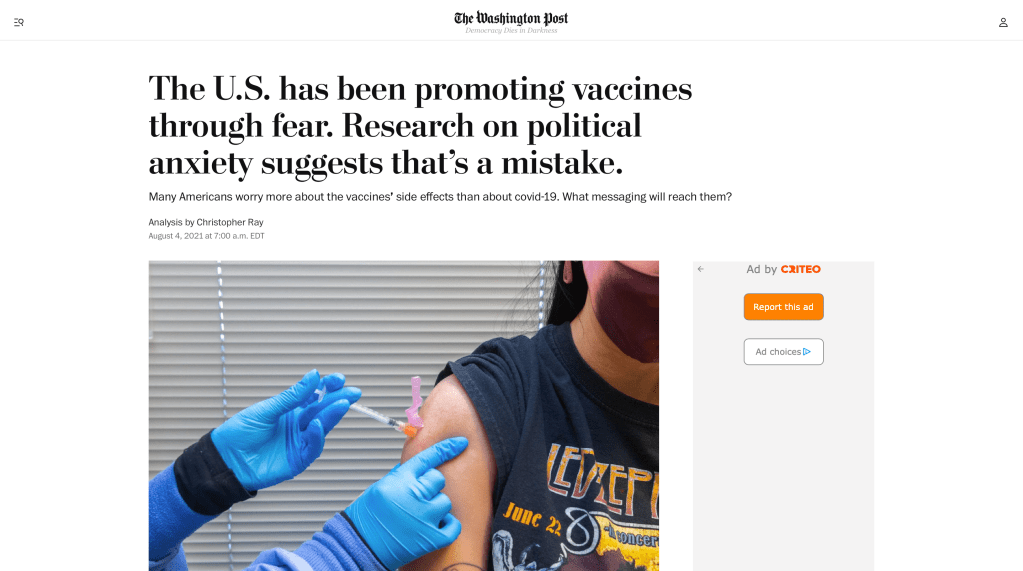
Policy commentary inspired by this project has appeared in The Washington Post:
The Washington Post: Monkey Cage (August 4, 2021)
 Christopher W. Ray